Guest Piece By Don Mullan
Over five decades after the Dublin and Monaghan bombings, the families of those murdered and injured are once again confronted with conclusions that purport to bring clarity yet leave the most serious questions unresolved. The recent Denton review, conducted under the umbrella of Operation Kenova, has been presented in some quarters as closing down the issue of collusion in relation to the attacks of 17 May 1974. For many families, however, and for those who have examined this case over decades, it has had the opposite effect.
This article is written in a spirit of respect and with full recognition of the immense harm the families and wounded have carried for over half a century. It is not an attack on Kenova as a whole, nor a dismissal of the work undertaken by its investigators. Rather, it is a critique of what the Denton review concludes – and, crucially, of what it does not – when measured against the evidential record, established patterns of state behaviour, and material long available but never properly examined.
What the Denton Review Says – and What It Does Not
The Denton review concludes that it found no evidence of collusion by British security forces in the planning or execution of the Dublin and Monaghan bombings, based on the material available to it. That statement, however, requires careful parsing. It is not a finding that collusion did not occur; it is a statement that no evidence was identified within the constrained evidential universe Denton was able to access and assess.
This distinction matters profoundly. Where evidence has been mishandled, delayed, withheld, destroyed, or never sought, a conclusion of “no evidence found” cannot reasonably be treated as an exoneration. At best, it represents an acknowledgment of investigative failure; at worst, it risks perpetuating that failure by treating the absence of evidence as resolution.
The danger lies not in what Denton explicitly claims, but in how its conclusions may be received and used: as a closing of the book, rather than as confirmation that the book was never properly opened.
Kenova’s Wider Findings and the Internal Tension
This narrow conclusion sits uneasily alongside Kenova’s broader findings. Across multiple investigations, Kenova has established that elements of the British security apparatus colluded with loyalist paramilitaries; that intelligence assets were protected at the expense of civilian lives; and that violence was allowed to proceed where intervention was possible but deemed inconvenient.
These are not marginal findings. They describe a systemic culture in which the management of intelligence was prioritised over the prevention of murder. Against that backdrop, it is legitimate – indeed necessary – to ask why the most lethal attack of the conflict in the Republic of Ireland should be treated as an anomaly, insulated from patterns established elsewhere.
The question is not whether Kenova uncovered collusion in every case it examined. The question is whether it is credible to treat Dublin and Monaghan as somehow beyond the reach of practices shown to have operated repeatedly in other contexts.
Operational Sophistication and Military Capability
One of the Denton review’s implicit assumptions is that the bombings were carried out by loyalist paramilitaries acting alone, using capabilities available to them at the time. This assumption does not withstand technical scrutiny.
Former US military ordnance expert Ed Komac examined the Dublin bombings and concluded that the three devices detonated in the city were synchronised and deployed with a level of precision consistent with professional military expertise. They were timed to deliver a political message and achieve maximum lethality in crowded urban locations, detonated within minutes of each other, and executed with a degree of coordination that loyalist paramilitary groups in 1974 were not known to possess.
This assessment does not rest on speculation. It rests on blast timing, placement, and execution – the hallmarks of trained operators. If the operational sophistication exceeded the known capacity of loyalist groups at that time, then the relevant question is not who later claimed responsibility, but who possessed the expertise to enable such an operation.
Forensics and the Broken Chain of Custody
Any serious assessment of responsibility must confront the apparent catastrophic failure of forensic handling in the immediate aftermath of the bombings. Bomb debris was not secured or analysed promptly. There was an eleven-day delay before material was sent outside the jurisdiction to the forensic laboratory in Belfast. No credible chain of custody was established. Evidence was handled inconsistently, identities were confused, and responsibility for transfer was disputed.
Such failures are not minor procedural errors. They are foundational. Forensic evidence, once compromised, cannot be rehabilitated by later review. Yet the Denton conclusions necessarily rely on a forensic record that was irreparably damaged at source.
It is therefore deeply problematic to treat the absence of definitive forensic conclusions as neutral, when the very conditions required to reach such conclusions were never met.
Dr James Donovan and the Evidence That Went Nowhere
The late Dr James Donovan, a respected Irish forensic scientist, examined debris from the Parnell Street explosion and identified prills of ammonium nitrate – a significant finding. In the course of my investigations, he expressed surprise that Irish authorities never followed up with him, never questioned his conclusions, and never sought to explore their implications.
Prills are not conjecture. They are physical artefacts. Their presence raised obvious questions about the source of the explosives used in Dublin. Yet those questions were never pursued.
It is difficult to avoid the conclusion that lines of inquiry were not merely neglected but consciously avoided.
Clonagh, Explosives, and What Was Known
Any analysis that excludes the Irish Industrial Explosives Factory at Clonagh, County Meath, is incomplete. Detailed contemporaneous reports by Irish Army officer Patrick Walshe documented a scandalous lack of security at the factory, describing it, in effect, as a supermarket for bombers. Vast quantities of explosive material were inadequately secured, poorly monitored, and easily accessible.
Former Taoiseach Garret FitzGerald later confirmed that the British Army had known for at least eighteen months that explosives used by the IRA were leaking from a factory in the Republic, and had failed to inform the Irish Government, preferring instead to use the situation as a propaganda weapon. Subsequent documentary evidence released through the Bloody Sunday Inquiry revealed that British authorities had, by the early 1970s, developed the technical capacity to analyse explosives and identify their source.
Taken together, these facts raise a disturbing possibility: that British security forces knew precisely where explosives were coming from, had the capacity to track and analyse them, and may have had access to confiscated IRA stocks. In that context, the hypothesis that loyalist paramilitaries were assisted – directly or indirectly – through the provision of explosives originating in the Irish Republic, and with British security force expertise, cannot be dismissed as mere conjecture.
Irish State Knowledge and the Handling of Evidence
There is, however, a further and deeply troubling issue that must be examined. Given the manner in which the forensic evidence was handled following the Dublin bombings – including its effective disappearance for some eleven days, the longstanding failure to establish a credible chain of custody, and reported disagreements within An Garda Síochána at the time regarding the conduct of the investigation – the painful question must be asked whether Irish authorities, at an early stage, realised that explosives stolen from Clonagh had been used to bomb the capital.
This question arises not from speculation, but from documented historical context and demonstrable technical capability. In 2001, Derry solicitor Desmond J. Doherty, representing a number of the bereaved and wounded of the Dublin and Monaghan Bombings, uncovered documents marked Secret that had been released through the Bloody Sunday Inquiry. These records concerned the tracing and identification of explosives used in the North of Ireland.
Minutes from a meeting held at 10 Downing Street on 4 November 1971 – attended by Prime Minister Edward Heath, the British Army’s Chief of Staff General Sir Michael Carver, and senior intelligence officials – record discussions of “experiments…being made…with the view to incorporating into… explosive material some components which could be positively recognised after an explosion.”
This was followed by a meeting of the Joint Security Committee at Stormont on 18 November 1971, which reported “progress…on the possibility of marking explosives for identification purposes.” At that meeting, the RUC Chief Constable expressed the hope that “joint RUC/Garda discussions on the question of explosives control would be arranged at an early date.”
When the Committee met again on 2 December 1971, members were briefed on methods being adopted by manufacturers to identify explosives and questioned whether an officer should be appointed to trace the source of explosives being trafficked into Northern Ireland.
It is not yet known how these discussions and recommendations progressed and, subject to correction, it appears the Barron Report did not evaluate these documents. However, if the measures discussed at Downing Street and Stormont in late 1971 were implemented, it follows that both British and Irish authorities would have possessed the technical means to analyse explosive residue and determine its origin.
This possibility is reinforced by a telephone conversation I had on 10 February 2003 with Pat Cosgrave, Manager of the Irish Industrial Explosives Factory, who confirmed that an identification marking process was introduced into explosives around 1971–72, and that responsibility for the control of non-military explosives lay with the Irish Department of Justice.
If such identification markings were indeed in place, it follows that Irish authorities may have had the capability to establish at an early stage that the explosives used in Dublin originated from the Irish Industrial Explosives Factory at Clonagh. In that context, the mysterious disappearance of the bomb debris and its subsequent transfer to Belfast – after a period during which forensic value would inevitably have been substantially degraded – takes on a profoundly different significance. It raises the grave question of whether evidential traceability was allowed to lapse in order to avert the political and public fallout that would have inevitably followed had citizens realised that the bomb material which devastated Dublin originated within the jurisdiction of the Irish State itself.
Beyond Denton: The Scale of the Implication
The international implications of the atrocity must also be evaluated. If British military personnel assisted loyalist paramilitaries in carrying out no-warning bombings in the Republic of Ireland, the consequences would dwarf Bloody Sunday in both scale and gravity. This would not simply constitute excessive force or battlefield misconduct, but the facilitation of mass civilian murder across a sovereign EEC border, undertaken with full knowledge of the likely consequences.
And it was not only Irish citizens who perished. Among the dead were an Italian citizen and a young French Jewish woman – a survivor of the Holocaust.
The possibility that agents of a democratic state may have enabled the deliberate killing of civilians, including foreign nationals, on the territory of a neighbouring sovereign state demands the highest level of scrutiny, not the narrowing of inquiry.
Returning to the Families
And so I return, as I must, to the families.
Because whatever the Denton review concludes, and whatever Kenova’s wider work illuminates or leaves unresolved, the Dublin and Monaghan families are still living with the consequences of a crime that has never been honestly confronted by the full weight of the British and Irish States.
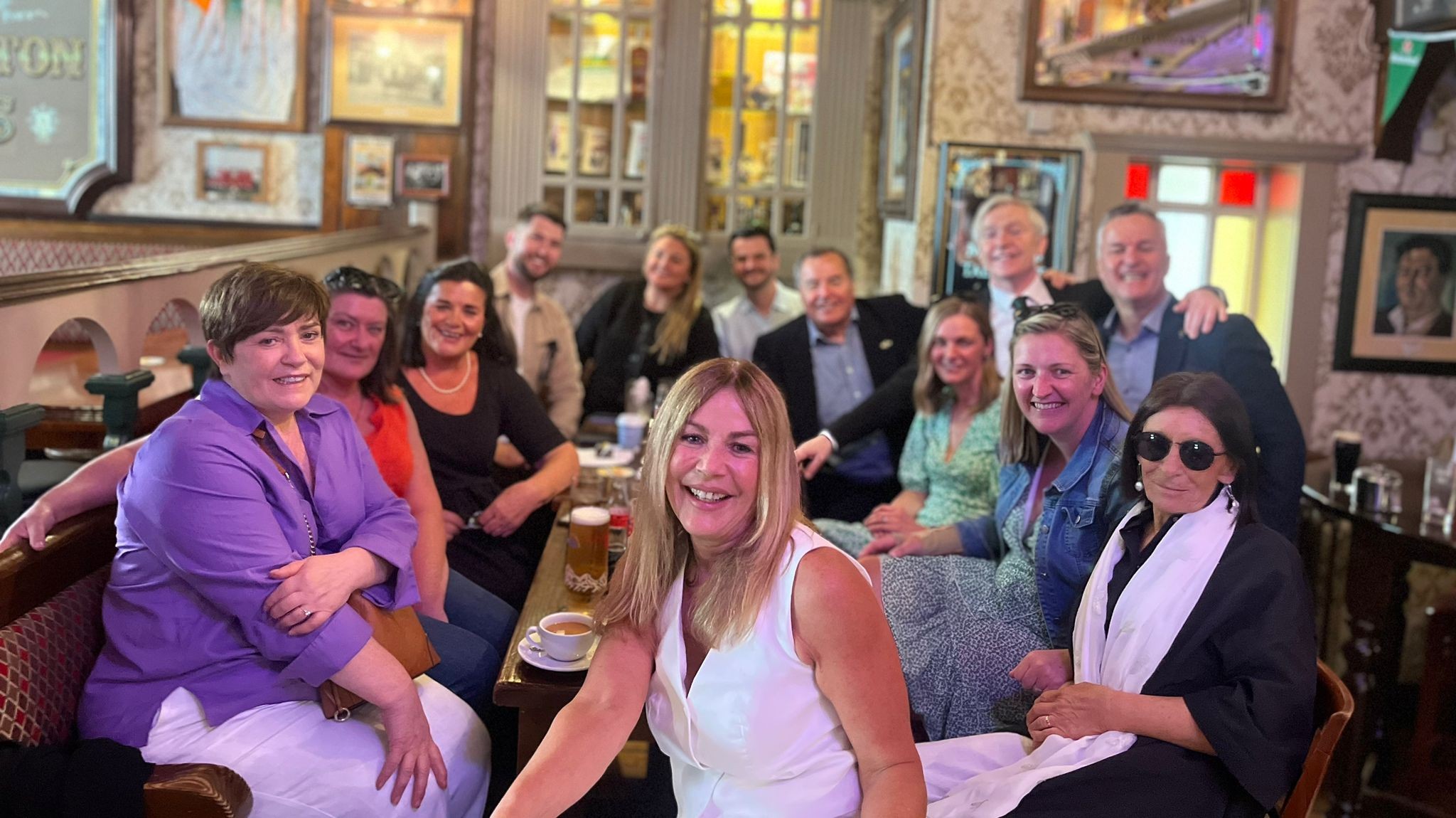
On 17 May 2024, during the 50th anniversary commemorations in Dublin, President Michael D. Higgins attended and rightly honoured the memory of those murdered and wounded. Following the official ceremony, the O’Neill and Massey families made their way to Molloy’s Pub on Talbot Street, where I was invited to join them for a cup of tea and some finger food in reflective memory.
These are remarkable families. Denise and Angela O’Neill, daughters of the late Edward O’Neill, who was murdered in the Parnell Street bombing, originally founded the group Justice for The Forgotten in 1988. They have shown extraordinary resilience and courage throughout their dignified quest on demanding nothing short of the full truth with accountable justice. Moreover, their strategic foresight for what was and remains a prerequisite for the above, a full judicial public inquiry, stands vindicated post Denton.
I was humbled to join them in what was a simple, human moment, away from formality – the kind of space where memory is carried honestly. Denise spoke of her ninth birthday, which fell on 17 May 1974, the day her father was killed – a birthday that, from that year onward, could never be separated from remembrance.
We spoke too of the following day, 18 May 1974, when Angela and her brother Billy were due to make their First Holy Communion. It was for that reason that Edward and his two sons had been at the barbers that afternoon, getting their hair cut for a ceremony that was meant to mark a moment of family joy.
We also spoke of Marta O’Neill, who was pregnant at the time of the bombing and who lost her baby as a direct consequence of the trauma she endured. Her loss speaks to a truth that statistics and reports cannot capture. That the violence of that day did not end with those who were killed outright, but continued into bodies, families, and futures that were irrevocably altered. The human cost of this atrocity is not contained in any report. It lives in families, in fractured childhoods, in rites of passage forever marked by violence, and in lives lived with a weight that cannot be laid down.
Anna Massey, who was killed in the third of the Dublin bombings on South Leinster Street, had celebrated her twenty-first birthday just five days earlier, alongside her twin sister, Muriel. The evening before the bombings, Anna and her fiancé, Tommy Geoff, sat with her parents, Anne and Frank, and her sister Catherine, writing wedding invitations. Anna and Tommy were to be married on 26 July. She was to be the first of the seven Massey sisters to marry – a moment of family anticipation and joy that was extinguished the following day.
I recall this gathering in a Dublin pub with profound sadness as it reveals something essential. Even fifty years on, the deepest truths of Dublin and Monaghan are still carried in quiet conversations, among those who remember – often away from the official spaces where history is formally acknowledged.
This article is accompanied by a photograph taken in Molloy’s that day. It is, in its own quiet way, a historical document. It records a moment of shared remembrance and continuity – one that invites reflection on how, and with whom, we choose to remember.
And until the story of Dublin and Monaghan is addressed in a way that fully honours those lived experiences – with truth, transparency and respect – it will remain what it has always been: not only a story of mass murder, but of a society still struggling to face all that this atrocity implies.
Don Mullan
Author Eyewitness Bloody Sunday (Wolfhound Press 1997, Red Stripe Press 2022) and
The Dublin and Monaghan Bombings (Wolfhound Press 2000).


