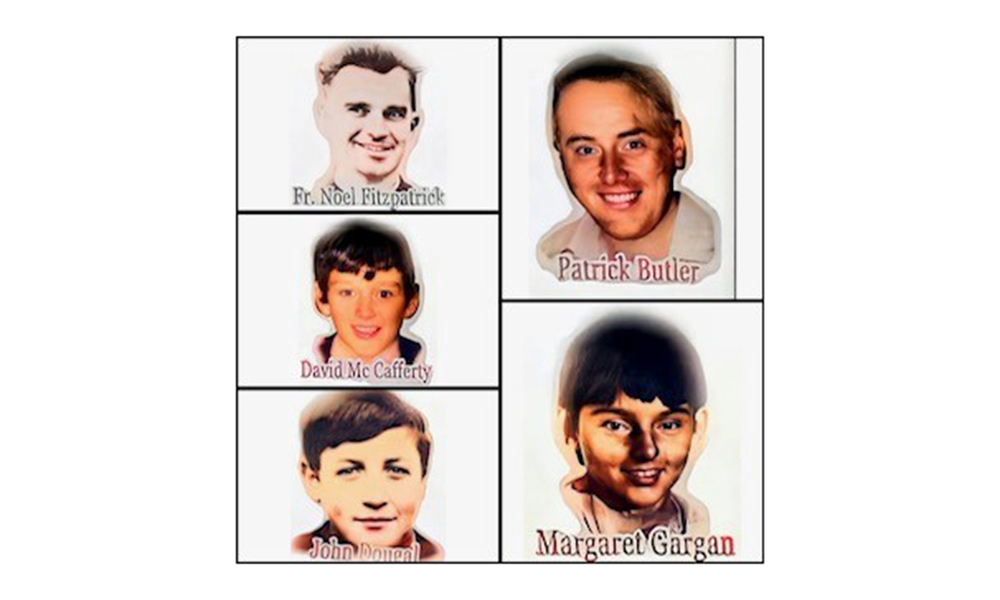
At 9:50 pm on the 9th of July 1972, the British army 1st King’s Regiment C Company opened fire on the Springhill/Westrock community, killing five civilians who posed no threat: John Dougal (16 years old), Father Noel Fitzpatrick, father-of-six Patrick Butler, David McCafferty (14 years old), and Margaret Gargan (13 years old). Two other individuals – Brian Pettigrew and Martin Dudley – were severely injured by British soldiers in the attack.
Though an inquest was held in July 1973, the British army controlled the narrative, falsely claiming that victims were gunmen carrying out a coordinated attack on the soldiers’ covert operations post.
In reality – now legally acknowledged as truth in findings delivered to a packed courtroom today – the victims were civilians who posed no threat. The soldiers were in clear and direct violation of the rules of engagement when they opened fire; furthermore, they concocted the story about gunmen to justify the unjustifiable: the murder of three teenagers, a devoted father, and a priest.
A fresh inquest was ordered in 2014, and finally opened on the 20th of February 2023. With the Legacy Act’s looming deadline, presiding coroner Justice Scoffield sped up the 70-day proceedings, hearing evidence into evenings and over several weekends, to ensure the inquest could not be shut down. The hearings concluded in the eleventh hour, on the 30th of April 2024 – and now, two years later, the findings have finally been released.
The court was full of family, friends, politicians, press, neighbours, and advocates – the support was so expansive that the courtroom was changed to accommodate the large crowd. Even so, community members gathered in two separate locations to follow a live stream of the proceedings, while other family members joined from locations across the world. While the show of support is a testament to the victims and their families, it is also important to acknowledge the many loved ones who died before seeing the vindication. Tragically, three family members died during the inquest proceedings and wait for the findings.
In the 600+ page document, Justice Scoffield noted that the scale of missing documentation from the British army gives rise to suspicion that documents were intentionally removed for ‘improper’ reasons. He also emphasised the soldiers seem to have tailored their accounts, either in poor recollection or ‘a cynical attempt to justify shootings which were unjustified’.
While he was barred from determining whether the soldiers’ use of force was justified, he was clear that the use of force was ‘unreasonable’ and in clear and direct violation of the yellow card. Further, he found that – in all cases but John Dougal – the soldiers ‘lost control’, firing prematurely and without control. The soldiers, he said, could and should have been able to see clearly that the victims posed no threat and – in the cases of at least Patrick Butler, Fr Fitzpatrick, David McCafferty and Margaret Gargan – were clearly unarmed.
Relating to the individuals, the coroner found the following to be true:
John Dougal was shot in the back as he was ducking and running for cover from British army fire. The coroner was unable to determine whether he was armed; but regardless, he said, John Dougal posed no threat as he ducked for cover and ran away from the soldiers’ concealed firing position. Soldier A killed him with a direct, aimed shot.
Father Noel Fitzpatrick was unarmed as he went to tend to the wounded and injured. He was accompanied by Patrick Butler, also unarmed; and as the two stepped out of cover to run to the wounded, Soldier A fired a direct, aimed shot which first struck Fr Fitzpatrick and then hit Patrick Butler. Soldier A would have been able to see clearly that neither man was armed and they posed no threat; further, there are reports that Fr Fitzpatrick, wearing his clerical collar, was waving his arms to indicate he was no threat.
As an unarmed David McCafferty went to retrieve Fr Fitzpatrick’s body, Soldier A fired again, killing David McCafferty. Once again, Soldier A would have been able to see that David McCafferty was unarmed and posed no threat.
Meanwhile, Soldier E fired a direct, aimed shot that killed Margaret Gargan, who was standing talking to friends. At no point was any gunfire coming from her immediate vicinity, and Margaret was clearly unarmed and posed no threat. Soldier E would have been able to see this clearly.
The soldiers remain anonymous and will likely remain so, unless the Ministry of Defence miraculously locates the “lost” cipher list. Justice Scoffield is considering forwarding a file to the Director of Public Prosecutions for consideration of criminal charges. However, Justice Scoffield was unequivocal confirming what the victims’ families have always known: John Dougal, Fr Noel Fitzpatrick, Patrick Butler, David McCafferty and Margaret Gargan should not have been killed that day, and Soldiers A and E’s use of force was unreasonable.
The evidence in this inquest concluded just one day before the guillotine date imposed by the Legacy Act in 2024. One day more, and these findings may never have come to light. This is exactly what the Legacy Act was designed to do, and today will be very poignant for families whose right to inquest has been cruelly ripped from them.
Tonight it is only fitting to conclude by recognizing the victims’ family members, who have fought almost 54 years for truth, to write the state’s false history and who have shown nothing but dignity and fortitude in their fight for truth, justice, and vindication.


